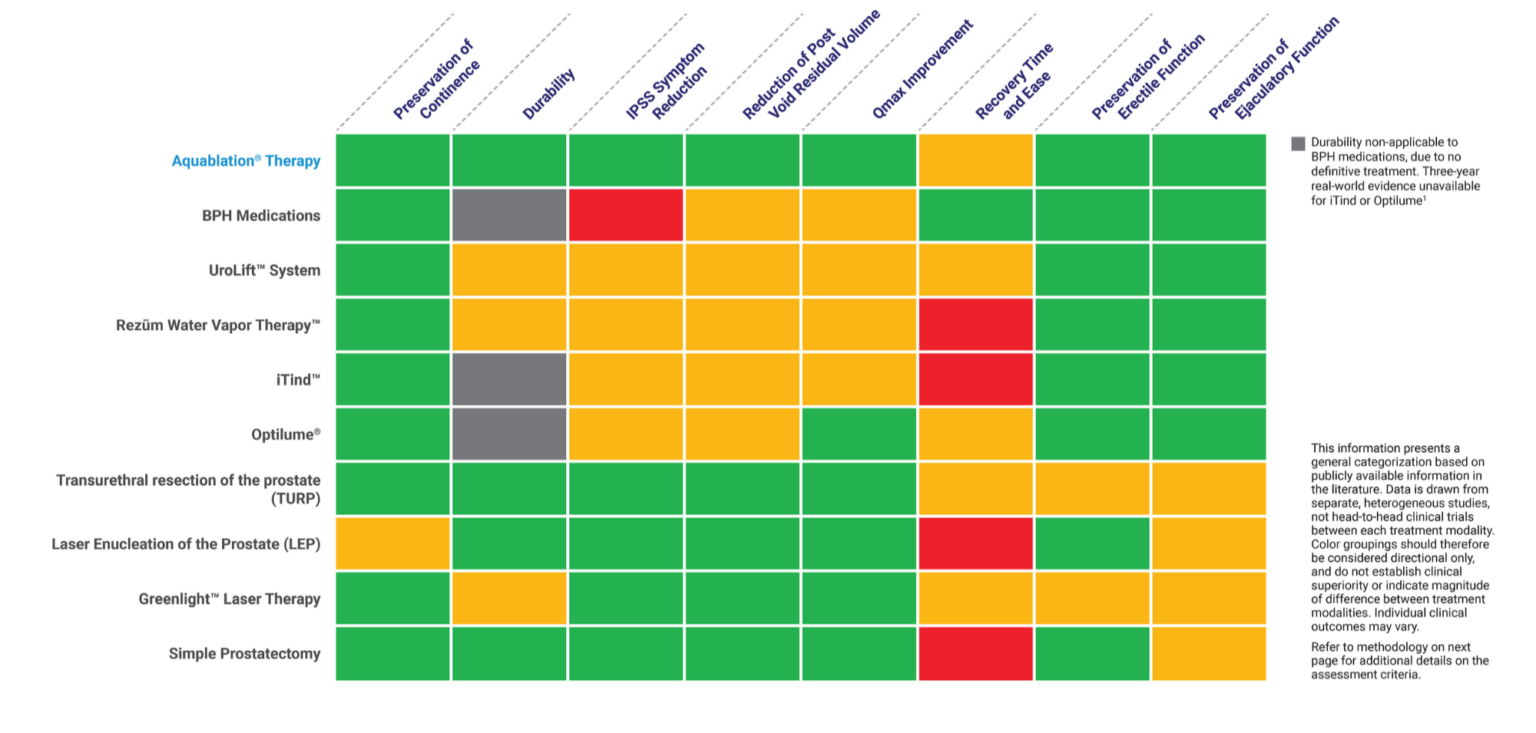
Based on published data citing Aquablation® therapy outcomes for categories including continence, durability, symptom relief, recovery and sexual side effects. Data is drawn from separate, heterogeneous studies, not head-to-head clinical trials between each treatment modality. “Complete” based on patient preferences (n=692; proprietary market research).
Methodology
Categories reflect the top patient priorities identified through patient market research commissioned by PROCEPT BioRobotics® and conducted by third-party research organizations. Note: IPSS, Qmax and PVR were all included as measures of the patient priority, magnitude of symptom relief.
Category Criteria
TURP, as the standard-of-care, is considered the benchmark for the graphic representation.
Preservation of Continence: rate of persistent urinary incontinence 2, 3, 5, 6, 11, 12
Durability: the proportion of patients who go on to receive an additional surgical intervention. Real-world-evidence (RWE) prioritized as source data, with minimum 3-year follow-up data available in third-party national healthcare database. Non-applicable to BPH medications, due to no definitive treatment. Other unrepresented procedures due to unavailability of 3-year RWE.1
IPSS Symptom Reduction: reduction in International Prostate Symptom Score (IPSS) from baseline. According to AUA guideline, Management of Lower Urinary Tract Symptoms Attributed to Benign Prostatic Hyperplasia (2023)16 – “There is nearly universal agreement that [alpha blockers] are all relatively equally effective in terms of IPSS improvement, with an expected range of improvement of 5-8 points, compared to an expected effect of placebo from 2-4 points.” Intermediate group identifies reported symptom reduction values above the range of symptom improvement from medications, but not clinically proven to be comparable to TURP.2, 3, 4, 9, 10, 11, 12
Reduction of Post Void Residual Volume: reduction in post-void residual volume, in mL2, 3, 4, 9, 11, 12, 13
Qmax Improvement: peak urinary flow, mL/s 2, 3, 4, 9, 10, 11, 12
Recovery Time and Ease: No single outcome measure to represent post-operative recovery experience is widely available in the literature, or collected using consistent methodology, to apply as the criteria. Therefore, the procedures differentiated from the intermediate group (default) reflect the following: BPH medications – no post-operative recovery period; Rezum – inferior patient recovery in the CLEAR trial14; iTind – additional procedure required to retrieve temporary implant; LEP – rates of post-operative incontinence3, 5, 6, 7; Simple prostatectomy – requires invasive surgical access.
Preservation of Erectile Function: erectile dysfunction measured according to International Index of Erectile Function (IIEF) after symptoms from immediate postoperative period expected to resolve. 2, 5, 6, 8, 9, 11, 12 Note: TURP as the reference point is categorized as low due to other treatments with lesser (more favorable) reported rates of erectile dysfunction.
Preservation of Ejaculatory Function: ejaculatory dysfunction measured according to Male Sexual Health Questionnaire for Ejaculatory Dysfunction (MSHQ-EjD) at 3 months follow-up.2, 5, 6, 9, 11, 12 Note: TURP as the reference point is categorized as low due to other treatments with lesser (more favorable) reported rates of ejaculatory dysfunction.
References
2. Tanneru K, et al. Indirect comparison of newer MISTs for BPH. J Endourol. 2021;35:409-416.
3. Ritter M, et al. WATER III: Aquablation vs laser enucleation.
4. Thomas JA, et al. GreenLight XPS vs TURP (GOLIATH). Eur Urol. 2016;69:94-102.
5. Leong JY, et al. Sexual dysfunction in BPH surgery. Curr Sex Health Rep. 2019;11:190-200.
6. Comiter C, et al. Urinary incontinence after prostate treatment. UpToDate. 2020.
7. Sapetti J, et al. Urinary incontinence after HoLEP. Prog Urol. 2019;29:101-107.
8. Khera M. Simple prostatectomy. Medscape. 2018.
9. Chughtai B, et al. iTind RCT for LUTS/BPH. Urology. 2021;153:270-276.
10. Lucca I, et al. Minimally invasive simple prostatectomy: systematic review. World J Urol. 2015;33:563-570.
11. Kaplan SA, et al. Optilume BPH (PINNACLE). J Urol. 2023;210:500-509.
12. McConnell JD, et al. MTOPS: long-term medical therapy outcomes. N Engl J Med. 2003;349:2387-2398.
13. Fiori C, et al. Robotic urethral-sparing simple prostatectomy. Urol Video J. 2022;14:100147.
14. Roehrborn CG, et al. Early experience with PUL vs WVTT (CLEAR). J Urol. 2024;211(Suppl):e752.
15. Gilling P, et al. WATER trial: Aquablation vs TURP. J Urol. 2018;199:1252-1261.
16. Sandhu JS, Bixler BR, Dahm P, et al. Management of lower urinary tract symptoms attributed to benign prostatic hyperplasia (BPH): AUA Guideline amendment 2023. J Urol. 2023;10.1097/JU.0000000000003698.
ML0858.A